
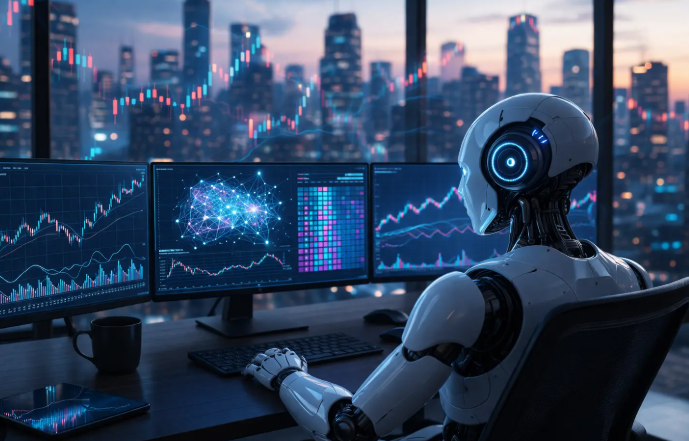
The advancement of artificial intelligence (AI) is transforming how market participants analyze financial instruments. In the trading of commodities—such as gold and oil—as well as stock indices, the volume of information that must be monitored is vast, ranging from price movements and technical indicators to economic data, central bank policies, and geopolitical sentiment.
AI can process this diverse array of information in a fraction of the time. The technology can be used to detect price patterns, identify support and resistance levels, correlate fundamental data with market movements, and track multiple indicators simultaneously. This makes the analytical process more structured and helps traders minimize the risk of overlooking critical information.
Another advantage is AI’s ability to discern relationships between different instruments. The movement of gold, for instance, is influenced not only by its own price chart but also by the US Dollar, US Treasury yields, Federal Reserve interest rate expectations, inflation, and geopolitical conditions. AI can help synthesize these various factors, providing traders with a more comprehensive view of market conditions.
Nevertheless, the use of AI does not mean that traders can delegate all decision-making to technology. AI can still produce flawed analyses, as market conditions can shift rapidly. Therefore, it is best to view AI as an assistive tool or a navigator, while the final decisions and risk management remain firmly in the hands of the trader.
Ultimately, the development of AI is not intended to replace human trading capabilities, but rather to enhance a trader’s capacity to process information. By leveraging this technology effectively, traders can save time, evaluate larger datasets, compare various scenarios, and make decisions based on more structured analysis. Technology provides direction and information, but the ultimate decisions remain with the human. (CP)